Monday, February 24, 2014

World's Largest Student-run Organization: AIESEC


Anyone that's known me for the past couple of years has probably seen my Facebook flooded with posts and pictures about some random organization called AIESEC. I joined AIESEC my freshman year at Carolina because one of my friends was in it and mentioned the opportunity to go abroad after joining. I had no idea what I was getting involved in, but at the time I just wanted to be a part of something. I wanted to meet new people and have new experiences and AIESEC just sort of fell in my lap at the right place, and at the right time. With that being said, I never would have guessed how much of an impact this organization would have on me over the past 3 years, and something about it keeps me coming back.

AIESEC is a not-for-profit organization that provides college students all around the world with leadership training and internship opportunities abroad. AIESEC is a french acronym meaning: Association internationale des étudiants en sciences économiques et commerciales (in English: International Association of Students in Economic and Commercial Sciences) but because we are a global organization whose member speak many different languages, we never use the extended name, solely going by AIESEC. Located in 124 countries with a network of 90,000 members, we are the largest student-run organization in the world. 

AIESEC local committees are dispersed around the world with each entity represented by a college or university. For students to open up a new chapter, they must be affiliated with an official college or university. AIESEC Chapel Hill  has been around for a little more than a decade and is housed at the University of North Carolina at Chapel Hill. This is the chapter I've been involved with since freshman year.

AIESEC runs it's organizational aspects similar to any small business. Each local committee has a president, an executive board of vice presidents, and five teams working together  towards a common goal. Members are motivated to work for this organization because we're all passionate about what we do and are so invested in creating life-changing experiences for other college students through cultural exchanges.

Over the next couple of blog posts I will go into more detail about our chapter here at UNC Chapel Hill, as well as my role within the organization and what I want to get out of it. This was a very brief overview of the organization as a whole and as I get  into more detail about AIESEC, I hope you'll gain a better understanding of why exactly we do what we do. Until then, take a look at this video!


A Week in Amsterdam

Earlier this month I had the opportunity to travel and work in Europe for a short, one-week run-in in Amsterdam. I've had a week or so back to reflect on my time and I've decided to share my experience in the form of a blog post. Enjoy!


I'll start out with the iconic I amsterdam  letters. This was one of the first things we saw the morning we landed in the Netherlands and was definitely the moment that it hit me, we were in Amsterdam! I say "we" because I was one of 15 students from the UNC School of Journalism to travel to Amsterdam with one of our professors, as part of an internship program.


Here is all 15 of us posing around the letters. As soon as we landed in Amsterdam, however, we were no longer called interns. Instead, we identified as reporters for our professor Gary's company: [rAVe Publications]. rAVe is an all digital publications company that covers everything to do with the audiovisual(AV) technology industry. And for a little under a week Amsterdam was housing the largest AV trade show in the world: Integrated Systems Europe.


This is a picture of the front of the convention center, referred to by all taxi drivers as: "the rai." Simply put, this convention center housed 12 hallways that could each multiple football fields inside of them. It was massive. This year's audience was at an all time high: 51,003 attendees.


This was the calm before the storm. One highlight of the trip was the daily breakfast! Here is our first team breakfast where we discussed the week's plan and prepared for our first AV trade show. Notice our uniform for this first day consisted of long sleeve t-shirts and pullover sweaters. 


After a quick setup of our booth, it was practice time. We had 15 journalism students reporters about to be thrown in to a massive trade show with thousands of products that most of us had little experience talking about before. The picture above is Russ and Molly practicing "product videos" with a cow sculpture. As reporters, our job was to visit every single booth on the show floor and shoot as many product videos as each company was willing to do. These were short, roughly one minute videos of someone from the company describing the product and giving an elevator pitch, in a sense, that we then return to them for free publicity. Our staff uploaded videos every night before they left the convention center, providing free marketing videos to every company at the show within 24 hours.

 
Once the show started, we worked long hours roaming the show floor, on our feet all day. It was hard work, but so fun. We had a quota of 50 videos to shoot every day of the show and for me this gave me a challenge to work towards. I thrive under competition so knowing that there was a goal to meet and that it wouldn't be easy to reach it was energizing to me.


Digital Signage. 4K. LED. HDTV. These are just a few of the buzz words we heard countless times at the trade show. I shot over 150 videos myself of various products such as the one shown above. After reporting at Integrated Systems Europe for a week I definitely left feeling more in the loop with the AV industry talk and blown away by the products and technology showcased.


I wanted to wrap this post up with a picture of some of us on our day off exploring the local market. For lunch we had felafel from a Dutch street vendor. This was probably my favorite meal in Amsterdam! I sit here a couple of weeks later counting down the days until I can return to that country. The energy in Amsterdam was exhilarating and I know that there's so much more to explore. Until next time, proost!


Monday, February 17, 2014

FANDOM

As we've reached the week of the Carolina vs. Duke basketball game, a lot of emotions are running through the minds of many UNC students. As seniors we are pretty much guaranteed tickets to the game, a prize we've waited four years for. And inside the Dean Dome we, as the students of UNC, play a certain role. We're the fans. We line up hours before the game starts, in the snow, just to have a chance at standing in the risers and cheering on our Tarheels as loud we can. As the current students, we are the biggest fans there.

Fandom is an interesting concept to me. A fan is defined as an enthusiastic devotee, follower, or admirer of a sport or other matter. By that definition I would certainly consider the hundreds of students who line up in the snow waiting to enter the game to be quite the fans. Their enthusiasm and love for Carolina Basketball is far greater than any amount of snow that could fall while they wait in line. But these aren't the only fans of Carolina Basketball. Fans are everyone at home that tune in to watch every basketball game, beer in hand, following each and every play as if they're right there with them. Fans are reliable and loyal to their team, no matter what.

On a different note, what does it mean to be a fan of a brand? I question how similar the enthusiasm is for a blue jean brand, for example, as compared to a National Championship basketball team. With that being said, I think it is possible for brands to gain followers, very similar to fans in the sense that they build a loyalty to the brand. If I found one brand of blue jeans in high school that I really liked, I'm probably going to continue to buy that same brand the next time I need jeans. This loyalty can grow to a point where no other brand is up to par, and you completely rule out the others.

In that sense, creating fans of brands sounds pretty ideal. If you took all of the followers of a certain brand and turned them into fans, imagine what this would do to that brand. By supplying those who are already interested in the brand with a sense of enthusiasm and devotion to the brand, you're adding an overall sense of energy. And energy means momentum, which is always good for a brand.

In short, one thing I've come across while crafting this post is that brands should really be trying to gain fans, not just followers. Their loyalty to the brand is supplemented with enthusiasm that is all and all better for the brand.


Monday, February 10, 2014

BBDO Creative Brief for Roudybush Pellets


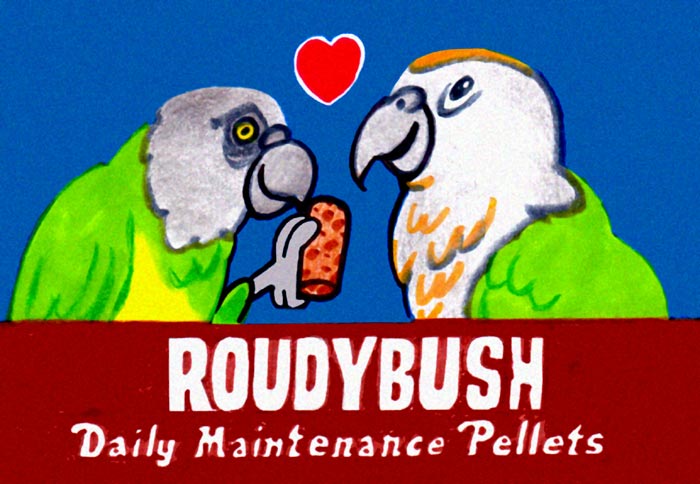
For this blog post, I came across a creative brief by BBDO for Roudybush Pellets. Roudybush Pellets are maintenance pellets for pet birds that fall under the category of specialized nutrition for better looking birds. Due to the relatively dry subject matter, this creative brief followed suit and detailed the strategy, positioning, and support in a relatively boring fashion.

BBDO's creative brief can be found at the following link:
http://www.unc.edu/~cachi/j171-roudybush.pdf.pdf

The brief was broken into ten categories that provide direction for where the creative should go with the Roudybush Pellets campaign. Those categories include USP (unique selling proposition), Long-Term Position, Communication Strategy, Brand Personality, Target Audience, Competition, Buying & Usage Habits, Values Attitudes and Lifestyles, Selling Proposition, and Support.

The thing that is unique to Roudybush in comparison to other animal nutrition supplements is that Roudybush specializes its products for various types of birds, as oppose to a generic bird supplement. Their long-term position is that Roudybush fosters a healthier, better looking bird. The brief details the brand personality, calling it: loving, caring, educated, direct, and serious.

One of the stronger elements to this creative brief, in my opinion, is their detailed target audience and acknowledgment that they're trying to reach a very specific type of pet owner, not just anyone. They label these individuals as "serious bird owners," and even categorize the birds as those that have longer life spans (20+ years). The creative brief also acknowledges that these are bird owners who are willing to spend more money on bird food that is higher quality and is nutritionally well-balanced. Roudybush consumers are most likely males and females, 30 years of age and older.

The creative brief ends with a support section that describes its international renowned product as the safest, cleanest and all around best nutritional supplement that is specially formulated for specific birds. As oppose to their competitors, Roudybush eliminates potentially harmful bacteria, fungi, and insects by a steam pelleting process instead of boiling them.

In conclusion, I think the success of this creative brief was the simplicity and attention to specific details about the product. BBDO didn't try to oversell a product that isn't very interesting and really doesn't apply to a broad audience. Instead, they relied on pure facts that serious bird owners will resonate with and find confidence and a sense of loyalty with the brand.


Monday, February 3, 2014

Creative Process

Creative process.

In short, this is the steps one takes to produce a piece of work that is unique in itself and truly resonates with the intended audience for which the work is meant. However, creative is not easy and there certainly is no one way to go about doing so. Everyone has their own steps they take to reach a final creative product and this is called their creative process.

My creative process is not exactly the same every time, but there are a couple common trends that usually help me develop my thoughts and produce a more succinct creative plan. The first of which is collaboration. I'm a talker, and when given a creative task, I need the chance to talk out loud and bounce my ideas off of my fellow peers and friends. At the university level, this is perfect. Small group discussions, like group projects, are where I'm most successful. I like having an end goal to work towards and a small team to work with that shares the same drive towards reaching that end goal. For me, having people that want to succeed just as much as I do is so necessary. I need team mates to tell me when an idea isn't going so well, as well as support me when I don't have the confidence in my own ideas. The idea of working on a team is definitely reassuring for me and contributes greatly to my creative thinking.

Another, and perhaps less conventional part of my creative process is finding a distraction. There comes a point in my creative planning where I hit a road block and no matter how hard I try, I just can't find a way to move past that block. One way I've found to get around that hault is to find something that makes me laugh, and gets my mind completely off of the creative process. YouTube videos are one way I go about doing this. I love watching a quick video that has nothing to do with what I'm focusing on and just forget for a second. It seems counterintuitive but it really does prove successful when looking for creativity.

A cursor, blinking on a blank page, is painful for me. This symbolizes the start of a long road towards reaching the end goal that seems so far away. Although I know the creative will come to me eventually, it's hard to figure out which road to take in order to come up with the perfect creative. Being creative certainly isn't easy for me, but with the right tools and concentration, good creative work is achievable.